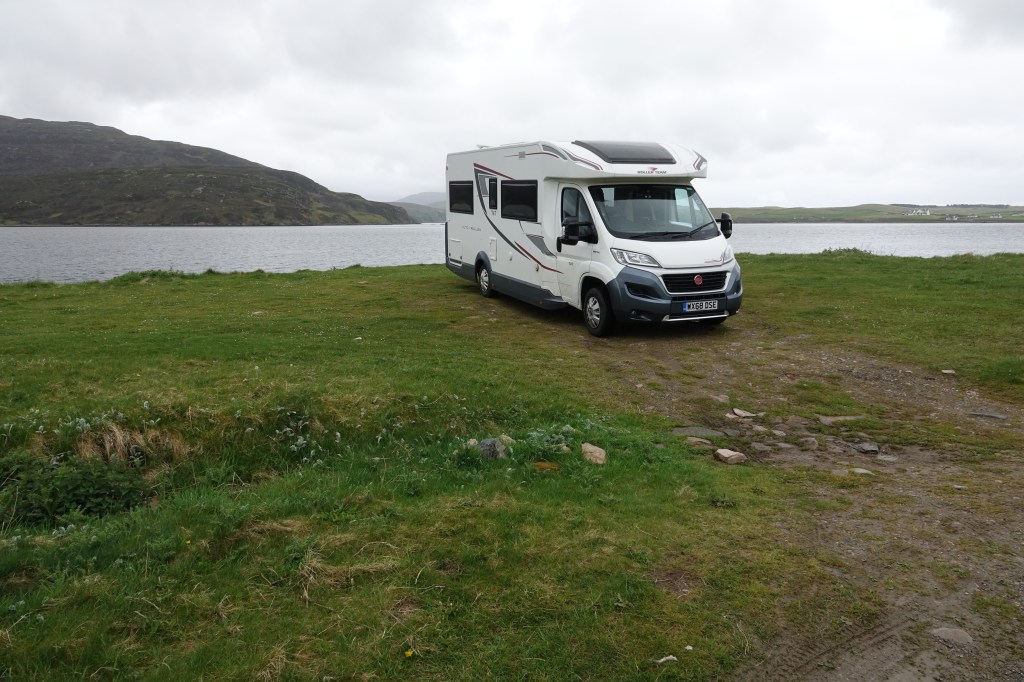
Just over a week ago two dear friends arrived in their motorhome.
Clive and Sarah rented out their house to go on a 12 month trip around Europe in their motorhome. Like many others, this was severely disrupted by Covid-19 and they needed to make a dash back to the UK, but had no home to return to.
Initially they spent many weeks on their daughter’s drive and got to see their new granddaughter.
Although we are great friends we are being careful with social distancing with a heavy dose of common sense.
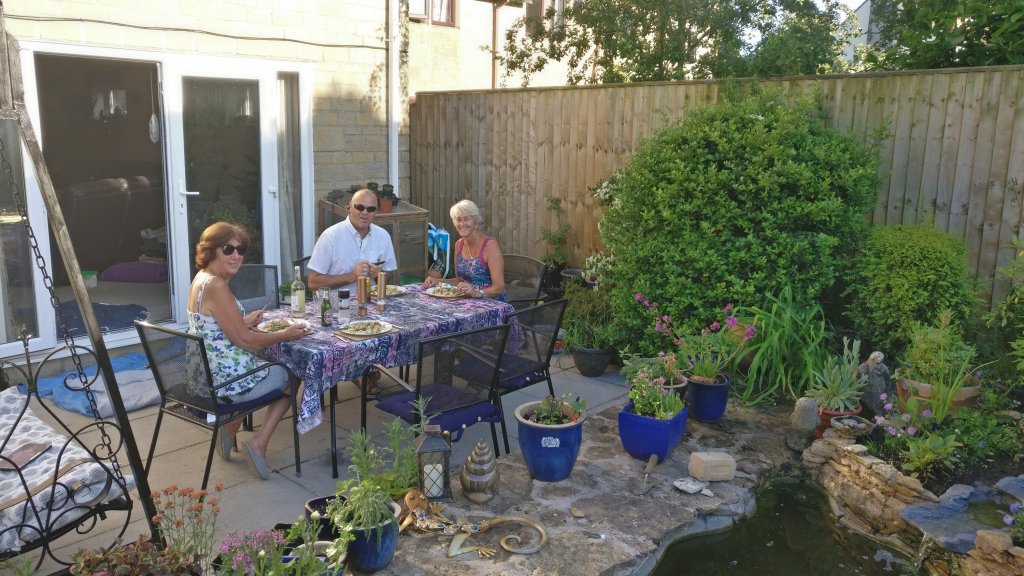
We had a socially distanced dinner together this evening. Clive and Sarah made a lovely Thai green curry, washed down with a few beers.
A year ago today we were at the most northerly point of the mainland UK, Dunnet head. It was our first ‘big’ trip away in Dizzy, and we had a blast. The weather was a little strange. When we arrived we couldn’t hardly see our hands in front of our faces due to the fog, and it was bitterly cold, but when we awoke the next morning, the fog had cleared and a beautiful day emerged.
We really miss being able to jump in the MoHo and explore different places, but we have great memories from past trips, we are keeping safe, we are enjoying our garden and we can plan our next trip even though we don’t have timelines.
There are usually positives in all situations, but at times they are a tad harder to find, but keep looking.
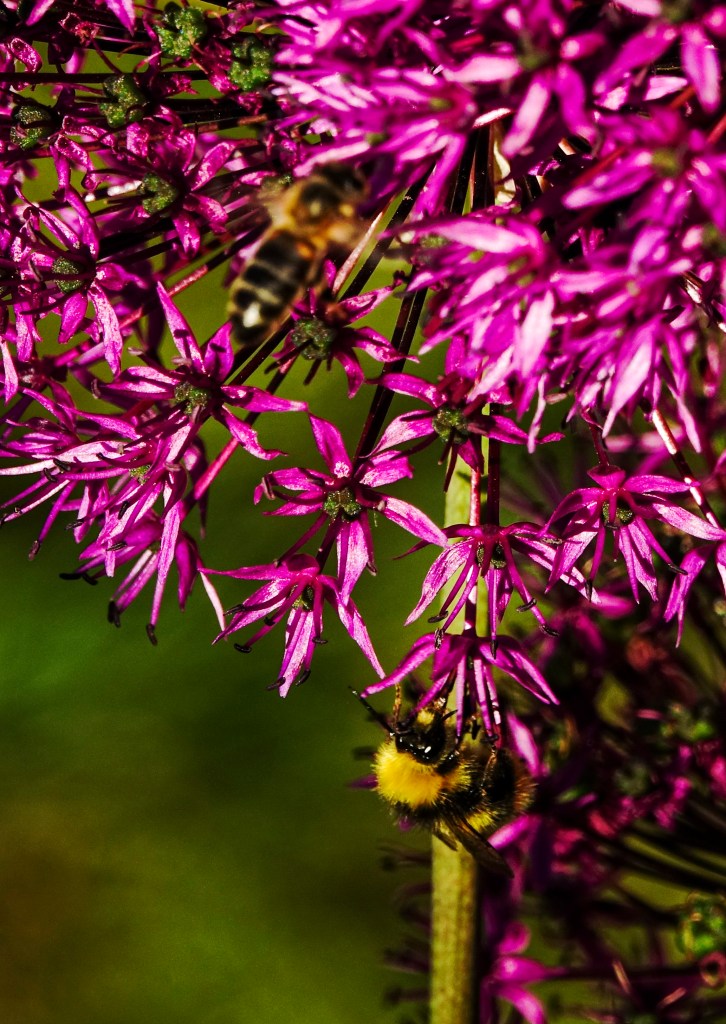
We’ve all see them, but do we appreciate them. Bees are so important to our agriculture, pollinating our crops. Without bees it is estimated our farmers would spend £1.8 billion to pollinate.
Bees also appear in many parts of our culture. From pub signs and town names, from Shakespeare to JK Rowling, from beehive hair-dos to phrases like “having a bee in your bonnet” – the bee has been a star for centuries. Pliny referred to honey as “the sweat of the heavens and the saliva of the stars”, while Chaucer was one of the first to use the phrase “busy as bees”.
The Honey bee is probably the best-known bee around, but over 270 species of bee have been recorded in Great Britain. Honey bees and bumblebees live socially, led by a queen and serviced by male drones and female worker bees.
Solitary bees tend to be smaller and their family unit is made up of a single pair. Although lots of solitary bees can be found in one area, they operate alone. Bumblebees are distinguished by their large furry bodies and species include the black and-yellow striped Garden bumblebee and Red-tailed bumblebee. Solitary bees include mason bees, leaf-cutter bees and mining bees. The Wool-carder bee strips hair from plants to weave its nest, while the Red mason bee lives inside hollow plant stems and holes in wood.
Since 1900, the UK has lost 13 species of bee, and a further 35 are considered under threat of extinction. None are protected by law. Across Europe nearly 1 in 10 wild bee species face extinction.
We already know enough to do something to help, even if some issues might need more research to be fully understood. Known causes of bee decline include things that affect us too. These include changes in land use, habitat loss, disease, pesticides, farming practices, pollution, invasive non-native plant and animal species, and climate change.
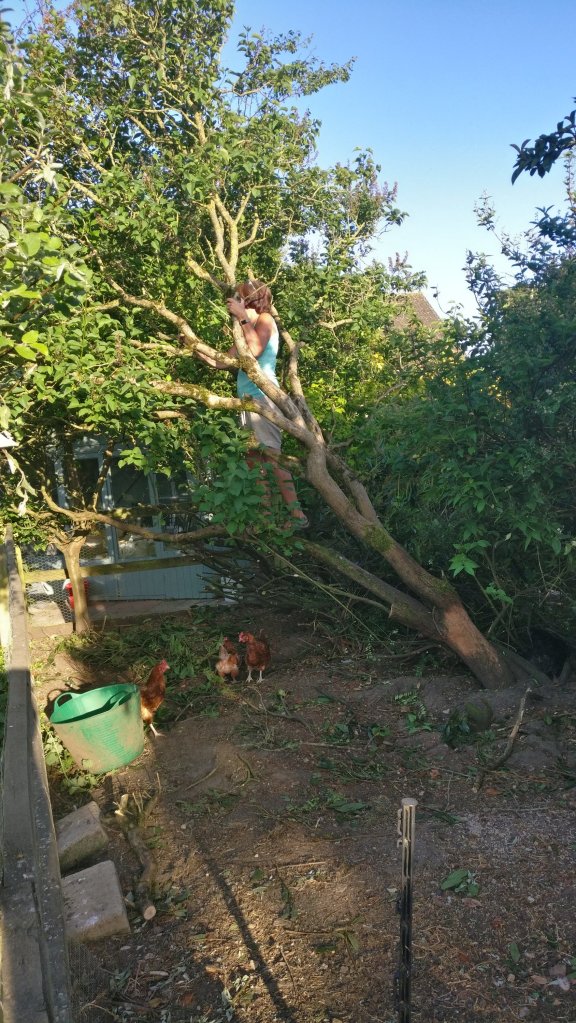
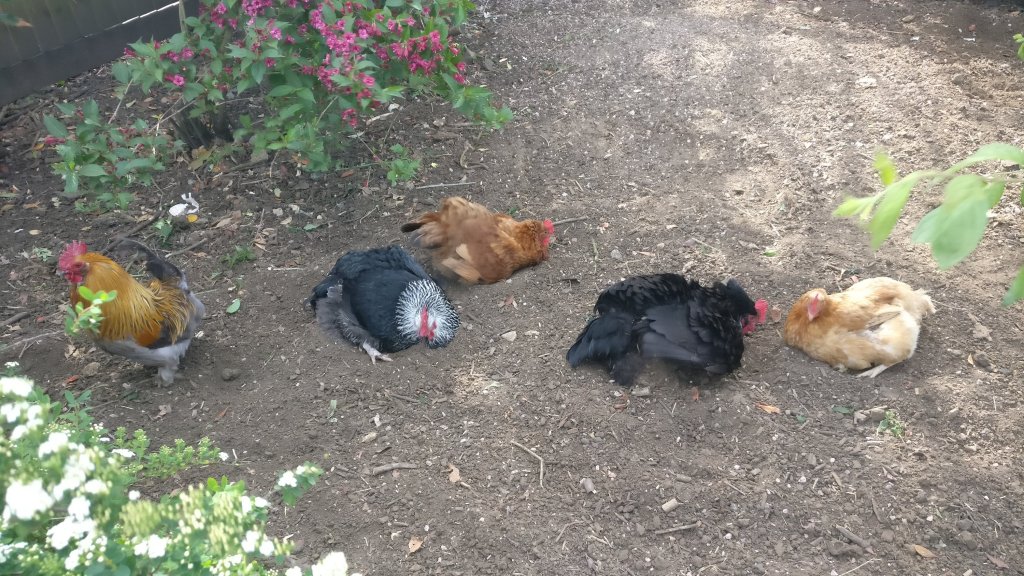
More work in the garden today, reclaiming a lot of ground in the chicken run by being brutal with the hedge cutter, chain saw and rotavator.
The chickens were delighted and immediately had a great dust bath.
Dust bathing is also a very important ritual for chickens, serving the purpose of keeping their feathers clean, improving feather water resistance, removing excess oil and keeping them free of mites, lice and other parasites. Basically a dust bath is the chicken equivalent of a shower- they get dirty to get clean, as strange as that may seem.
A little photo from my little wander with the woofers this afternoon. This little chap was busy flitting from one bush to another.
I have no idea what type is, nor whether it is a moth or a flutterby…. whoops butterfly 🙂 but it got me thinking about what it would be like to be a creature this small, with so many other larger animals roaming around.
Humans are pretty much top of the food chain. What would it be like to have other massive creatures around us? It is therefore strange that something so small, that we can’t even see, has become such a threat to us (Covid-19 virus). Stay safe my friends.
Update – It is a Brimstone Butterfly. Thanks to Andy Britton for identifying
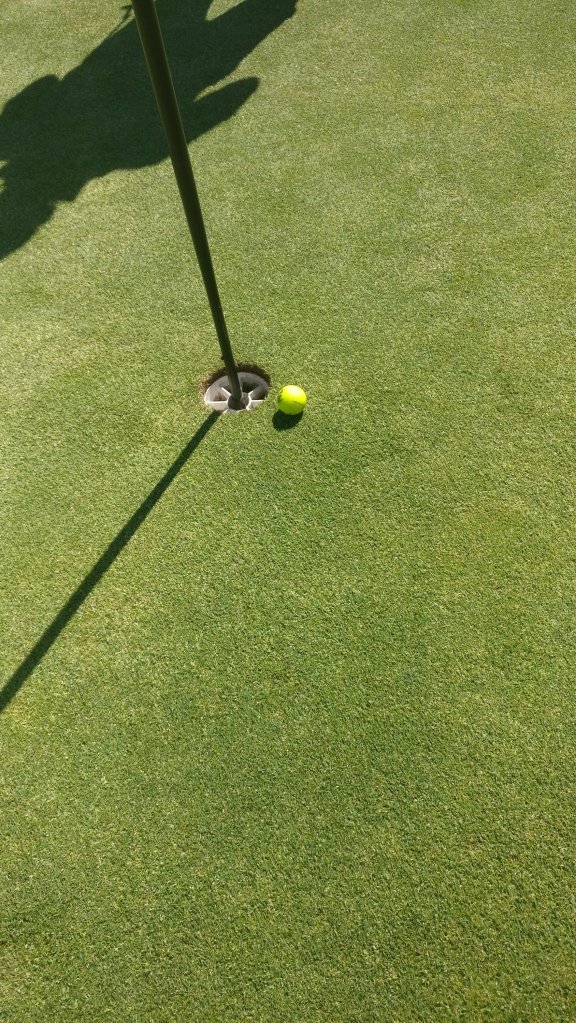
Thankfully golf courses are back open with covid precautions to help prevent the spread.
I play at Orchardleigh, and the depth of holes have been reduced, and flags are not allowed to be removed. Players must also stay 2 meters away from each other.
It is great to be back out playing again, especially on a day like today.
I’m not, nor will be the best golfer on the planet but I enjoy it, especially with the guys I play with. Great friendly banter, with lots of laughs.
Anyway, today I bagged a few points on hole 6, a 369 par 4 hole. Today’s photo shows the position of the ball after 2 shots!!!
Unfortunately the rest of the round wasn’t quite that good but it is nice to remember good things 😊

 New day - New Photo challenge